Saturday, August 21, 2021

Daggerford: Navine Shot First

Game Date: 8/21/2021

LocationRoll20
Campaign: Daggerford, Session 19

SystemD&D 5e
DM: Mike

The Party:
Azul (Cliff) Dragonborn Fighter
Nikolice Gomez (Steven) - Human Fighter (Absent)
Khemed (Rusty) Half-Elf Wizard
Navine/"Spider" (Steve) Elf Rogue
Vanya (Matt) Half-Elf Bard

The Session:
When we left off, we had separated from Khemed, and found ourselves face-to-face with the venerable Dwarven king.  We spoke to him for a bit.  Vanya managed to offend him at first, but Navine was able to recover for us.  The king told us a bit of the history of Illefarn.  He told us that the halls were plagued with both ghosts and Red Wizards.  We asked how he could help, but he didn't have much hope.  He said if we took out the wizards, the ghosts would overrun the halls, and vice versa.

We asked if we could have some help against the Red Wizards, who were also looking for the same Fire Key as we are.  He couldn't help, as he was bound by an agreement with the Red Wizards.  But a couple of his subjects agreed to help us.  We left the king to his depression, and explored more dungeon.  Our Dwarven escorts dissuaded us from the Northeast hallway, so we sent Navine to scout ahead.  The Rogue found a large empty room that looked like the site of a battle.  We saw more stairs, but decided to clear out this level first.

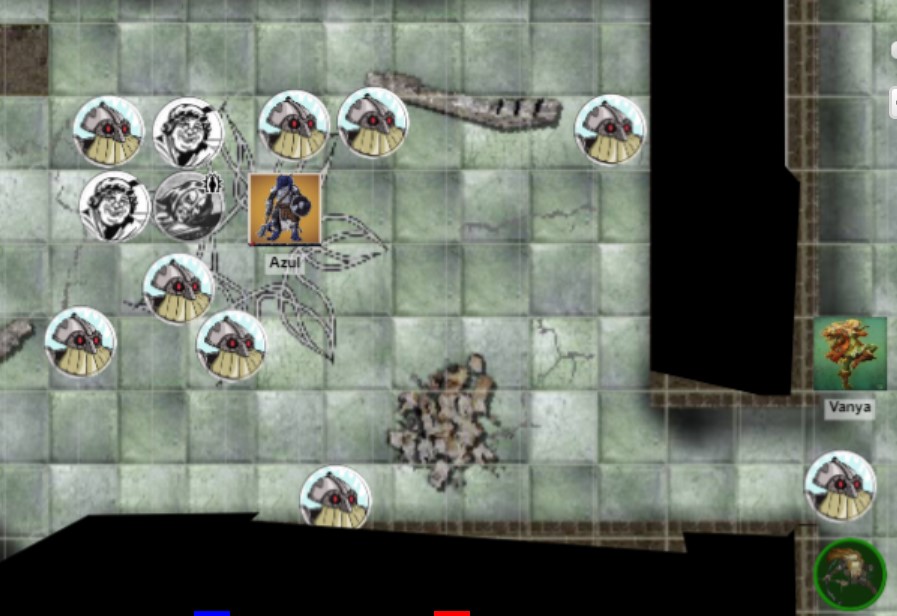
We kept checking out more rooms and hallways.  In a room to the Northwest, we saw a man in red robes, working on some masonry.  He was accompanied by two Dwarf assistants, and the room contained ten suits of Dwarven armor.  The wizard gestured us to wait, as he was engrossed in his work.  Navine shot the Red Wizard.


Azul rushed in, striking the wizard twice.  But then the suits of armor came to life, and surrounded the Dragonborn.  Azul used lightning breath, hurting the wizard and killing one of his bodyguards.  Azul escaped the room, but the wizard hit us with a fireball.  The suits of armor stopped attacking whenever we weren't in their line-of-sight, so we tried to stay out of the room as much as possible.

The wizard fired another fireball, then fled out the opposite door.  We spent a few more rounds  fighting the suits of armor.  A couple of Dwarves approached us from the South hallway, acting suspiciously.  Navine heard them speaking to each other using a Red Wizard dialect.  The suits of armor were immune to Vanya's Vicious Mockery, so she helped to revive one of the NPC Dwarves who had been hit with a fireball earlier.

With four suits of armor remaining, we decided to drop out of combat and leave the room alone.  We headed toward the king's chambers, but as we reached that hallway, we saw two undead creatures guarding the front of the entrance.  We sneaked past them and continued South.  We heard a commotion further South, and went to check it out.  

Navine scouted ahead.  Several disheveled people ran past her, including some Elves and Halflings.  Then she came across a chaotic scene involving Khemed, more wizards and some undead.  We're not even sure which side Khemed is on at this point, but we ended the session on that cliffhanger. 


The Ups and Downs of Metagaming

Usually, if someone talks about metagaming, they're specifically referring to the act of using out-of-character knowledge to give yourself an in-game advantage.  For example, your character has never heard of the exotic monster you now face.  But you, the player, has read the Monster Manual, and you know that this monster is weak to cold.  Your character uses this out-of-game knowledge, and defeats the monster using ice spells.

Some consider this cheating, some consider it a necessary evil to speed up combat, and some just don't really care.  But that's not really the point of this blog.  Today I want to talk about some of the less commonly recognized forms of metagaming.  


Eleven years ago today, I played a D&D 4e session that took place on a zombie-infested island.  I'm not going to link to the session, because I don't want to blatantly call out the problem player by name, but you can find my session recap if you look hard enough.

One of the players, let's call him José, was a bit of a rules lawyer.  He had a reputation for being good at combat tactics, which is probably why he liked 4e so much.  But he also had a tendency to pick fight over flight, even when all signs were pointing to flight.

In this session, scores of zombies converged on us, herding us towards a church.  The plot required us to take refuge in the church.  Tactics-wise, our smartest move would be seek refuge in the church.  Common sense told us that we would be safest in the church.  Really, the DM might as well have shown us giant red arrows floating in the sky, pointing at the church.

José would not be herded.  He had total confidence that his character could survive hundreds, if not thousands of zombies.  For him, D&D was about combat, so this was heaven for him.  The rest of us were a bit less enthused by the endless hordes.  Especially the squishy bard and warlock.  

Since José wouldn't follow us toward the church, we climbed onto the roof of a house.  A few zombies tried to climb after us, but they were incapable of making it that far up.  We were safe to pick off zombies from a distance, with little risk.

But José wouldn't have it.  He didn't want to climb onto the roof, because he didn't have any decent ranged attacks.  But he also didn't like that he was the only one taking damage.  So he resorted to psychological warfare - he gave us a guilt trip.  "Your hit points are a party resource," he told us.  "Now get down here and take your licks with the rest of the party."

Our bard and warlock were not designed for melee.  The warlock in particular was a glass cannon.  From the roof, he could take out three or four zombies per round.  My bard wasn't quite as destructive, but her support abilities were still helpful to the other characters.  On the ground, getting pounded from all sides, neither the bard nor the warlock would have lasted three rounds.  But José, who considered himself a master tactician, tried to make us feel bad for maintaining our position.

And at the time, we did feel bad about it, and we even started to climb back down.  But we somehow managed to convince him that our opponents were infinite, that this was more of a roleplay encounter than combat, and that he wasn't really earning more XP so much as bleeding out his own resources.  We fled to the church and barricaded the door behind us, surviving to play another session.

"Your hit points are a party resource" burns me to this day.  Not only was José's request tactically unsound, but it reduced our characters to numbers on a sheet.  In a way, that sums up everything I didn't like about Fourth Edition.  It's like it was designed from the ground up to make people think of their characters as data instead of people.  

José's request was also metagaming, to a degree I hadn't previously experienced in a D&D game.  Our characters weren't exactly cowards, but it still would have been insanely out-of-character for them to do something so reckless as to dive into a swarm of zombies just to get XP.

Of course, it was also metagaming for me to recognize it was a plot encounter.  I knew early on that zombies would keep spawning forever, because the goal was to herd us to the church.  But it was also the most logical thing for our characters to do, so that little bit of metagaming wouldn't have hurt the story.


Since then, I've seen a lot of metagaming from both players and DMs, but never anything that dramatic.  One thing people forget is that metagaming works both ways.  Sometimes players act on knowledge they couldn't have had, sure.  But sometimes the players are denied knowledge their characters should have.  In both cases, out-of-game knowledge (or lack thereof) influences in-character actions.

One fun part of D&D is solving puzzles.  Unfortunately, sometimes the players aren't as smart as the characters.  It's always funny when character with intelligence as their dump stat solves the puzzle, simply because that was the player who figured it out.  But other times, the party is stumped even though some of the characters have 20 INT.  

Of course, a good DM won't let the story grind to a halt over such a thing, and will give the players hints in exchange for INT checks, or have an NPC help them.  But it can be frustrating playing a character smarter than you are, when most of the puzzles are designed for the players to solve, rather than the characters.  

My point is, it isn't really metagaming for a player to ask for hints to solve a puzzle.  The metagaming occurs when the DM requires an 8 INT player to solve a puzzle his 20 INT character should have figured out instantly.


Back when I hosted a NeverWinter Nights server, I had a lot of talks with other module designers.  One of my designer friends didn't like the fact that the game showed the names of characters above their heads.  From a roleplaying perspective, this allowed you to know another character's name before you had actually been introduced.  He was looking for a way to disable that feature for his module.

I strongly disagreed.  As I explained to him, NWN only had about ten heads for each race.  This did not mean that humans only had ten different faces in Faerûn.  The fact is, the characters had access to more data than the players did, because in-character, they could recognize each other's faces.  Having our names over our heads was an out-of-character tool that actually helped players stay in-character.

I mean, what if two players happened to use the same head, and wore similar outfits?  This actually happened to me on multiple occasions.  If it weren't for the names over our heads, the rest of the party wouldn't have known who was who.  Does this mean they were twins in-game?  Obviously not.  From the characters' point of view, they would have had completely different faces.


One NWN server I played on was very strict about roleplaying.  I liked the RP-heavy environment it created, but sometimes the moderators went too far and it actually broke the immersion.  The moderators often complained that players leveled too fast, they spent too much time farming for XP, and that they treated death like a slap on the wrist.

They often threatened to make death more permanent, so that players would pick their battles more carefully.  It sounds good on paper, I guess, but did they consider how often PCs got killed by lag?  Or server crashes, or their computers locking up?  I'd be pretty pissed if my computer crashed, and when I got back in my character was permanently dead, all in the name of "better roleplaying."  There's nothing "in character" about that, just bad moderators.


A more recent example is from my current Daggerford campaign.  In an early session, my bard decided to fire a Shatter spell into a room full of centipedes.  This turned out to be a bad idea, because another party member was in the room with the centipedes.  So why did she fire?  That's not like her.

Well, it's because we were using Roll20, and the other party member was occupying the same space as a centipede swarm.  Roll20 displayed the centipede token on top of the character token.  In character, Vanya definitely would have seen her teammate in there, fighting off the centipedes.  The other players warned me it was a bad idea, but they only said that it was a waste of a spell slot.  None of them mentioned that there was a party member in there.

When I realized my mistake, I told the DM that I wouldn't have done it if the player's token had been visible.  But it was too late.  I still think it was a bad call by the DM, but everyone makes bad calls now and then.  The fact remains that my character would have made a different decision if we'd been playing in person, with miniatures.  

Requiring players stick to decisions influenced by interface problems is a form of metagaming.  Maybe not metagaming in the traditional sense, but it's still allowing out-of-game factors to affect the story.  The format should never change the plot.  

The bottom line is, while a little metagaming can be good for the game, most of the time it's a bad thing.  But reverse metagaming - that is, letting out-of-character ignorance slow down the game - can be even worse.

Saturday, August 7, 2021

Daggerford: Splitting the Party

Game Date: 8/7/2021

LocationRoll20
Campaign: Daggerford, Session 18

SystemD&D 5e
DM: Mike

The Party:
Azul (Cliff) Dragonborn Fighter
Nikolice Gomez (Steven) - Human Fighter
Khemed (Rusty) Half-Elf Wizard
Navine/"Spider" (Steve) Elf Rogue
Vanya (Matt) Half-Elf Bard

The Session:
Last session ended mid-dungeon, on a quest to find the Elemental Key of Fire.  We were still hurting a bit from our last fight, so we took a short rest in the temple room.  During the rest, we felt like we were being watched, and we could hear some movement from elsewhere in the dungeon.  There was a large anvil in the center of the room, with "Praise Moradin" inscribed on it in Dwarven.  Khemed cast Detect Magic, and discovered that the anvil was full of conjuration magic.  We pondered trying to move the anvil, or interact with it in some way.

We tried striking the anvil with a hammer we found in a nearby room.  A spectral Dwarf child approached us, and gave us a warning. "Shh!  They'll hear you."  After a bit more interaction, he ran off.  We heard some other Dwarven voices from a nearby room.  Azul peeked around the corner, and promptly failed a perception check.  


A couple of Stoneghosts attacked Azul.  One of them phased through the wall and attacked Vanya.  After a couple of rounds, they both fled into the walls.  We decided to explore one of the rooms to the West, where we found the remnants of a classroom.  Azul heard another baby crying in the distance.  We noticed that the ceiling of the room was bulging, like it was about to collapse.

In another room we found a nursery, and some Dwarven picks in another.  Then we heard the howling of Orcs running toward us.  Several Clotskull Orcs and a Red Wizard quickly approached, and we rolled initiative.  One attacked Vanya, and two went straight for Khemed.  Nikolice pulled one Orc towards himself with his Psionic powers, and Azul finished that one off.  


The Red Wizard saw Khemed, looked afraid, and vanished.  One Orc hit Vanya with two greataxe attacks, dropping her.  Another one knocked Khemed down.  The rest of the party finished off the Orcs, and helped revive the downed party members.  Since two of us were out of hit points, the party retreated from the dungeon and looked for a safe place for a long rest.

While resting, Khemed received a message via Sending spell.  We managed to get through the long rest without any random encounters, and approached the dungeon fresh.  We checked a few more rooms on the ground level, nearly triggering a total ceiling collapse.  Then we approached the stairs.  Azul set off an alarm spell, but we proceeded upstairs anyway.  In the first room, there were some runes on the floor.  Down the West hallway, a couple of Dwarves hunched behind a table.  

Nikolice attempted to talk to them, and they shot him with a crossbow.  Then he held up some gold, and they stopped firing.  They gestured towards a North hallway, as if trying to warn us to be quiet.  Then a fireball came from down the North hallway, grazing Navine and Nikolice.  Some enemies approached from the North hallway.  Three Orcs, an Ogre, and the Red Wizard.


While the enemies were still clustered, Vanya fired off a Shatter spell, killing one Orc and damaging the rest.  The enemies charged down the hall.  On Azul's turn, he managed to hit three of them with his Lightning Breath.  When the Ogre missed Azul, the Dragonborn used his riposte to finish off the Ogre.  This left the Red Wizard, still down the hallway.  Khemed approached the Wizard, who recognized him, and dropped a wall of fire behind him.  We couldn't hear the discussion between Khemed and the Red Wizard.

When the flames finally went out, Khemed and the Red Wizard had vanished.  The rest of us ran down the West hall to talk to the Dwarves, who indicated that we should be quiet.  Navine tiptoed off to look for Khemed, while Azul, Vanya, and Nikolice followed the Dwarves.  The Dwarves didn't know much Common, but enough to communicate.  We asked them what happened here, and the Dwarves answered, "Curses."  The Dwarves gestured down one hallway and indicated that it held some prisoners.  

Navine kept sneaking around and exploring the hallways, found a nest of giant rats, and avoided them. Another hallway led North to a large room.  But before she could investigate it, some enemies in a South hallway spotted her and started to attack.  She fled and hid.  When one enemy approached her location, she sneaked past them and hid again.  

Meanwhile, the rest of the party continued to follow the Dwarves, unaware of Navine's plight.  Eventually they led us to the same hallways Navine was hiding in, and she rejoined the party.  The Dwarves led us to a room containing a distinguished older Dwarf, who they introduced as the King of Illefarn.  We ended the session on this cliffhanger.


Saturday, June 26, 2021

Daggerford: Baby Don't Cry

Game Date: 6/26/2021

LocationRoll20
Campaign: Daggerford, Session 17

SystemD&D 5e
DM: Mike

The Party:
Azul (Cliff) Dragonborn Fighter
Nikolice Gomez (Steven) - Human Fighter
Khemed (Rusty) Half-Elf Wizard
Navine/"Spider" (Steve) Elf Rogue
Vanya (Matt) Half-Elf Bard

The Session:
Last session left off with us traveling East, our eventual destination being Mount Illefarn to find the Elemental Key of Fire.  We made our way through the wilds, until we came upon some Elven hunters.  They were unhappy and suspicious due to the recent fires, but we persuaded them to hear us out.  They took us to their camp, where we met our newest party member, Nikolice Gomez.  


They told us that they had been hunting for a sneaky dragon who had been picking off their Elves.  We took a long rest and continued to Illefarn, traveling through heavy rain.  On our way, we found some dead Orcs and climbed some cliffs, taking refuge from the storms in a building.  We set out to explore the structure.

While examining a dragon statue, Nikolice set off a trap, causing Khemed to fall into a pit.  Nikolice used his psionic powers to levitate Khemed out of the pit.  While we attempted to deactivate the trap, we noticed three Dwarves in an adjoining room.  They turned towards us and accused us of being after their gold.  Combat ensued.


The Dwarves were actually "Stoneghosts".  They used an attack called "Calcifying Touch", which could cause both damage and exhaustion.  The fight began with Azul and Vanya on the wrong side of the pit.  Azul handily jumped over the pit, but Vanya remained and fought from a distance. 

The Stoneghosts also had the annoying ability to move through walls.  After the first two were killed, the third one phased through the floor, ending the encounter.  We fixed the trapdoor, and continued exploring.  While playing more with the dragon statue's tail, we found a secret compartment nearby with some goodies inside - a potion and a gold necklace with a warhammer pendant.

The next hallway split North and East, and we went East.  The next room contained a dead Ettin, and the ceiling looked like it was on the verge of collapse.  Nikolice walked around the edge of the room to check out a chest, which contained four 100gp gems and a Dwarven carving.  The next passage led North.

We found some more dead bodies - Orcs, Dwarves, and an Ogre.  We also found some little piles of sand, and noticed that some of the bodies were calcified.  In another room to the East, we found a workshop, which contained an iron safe.  The safe had a slot sized for a coin.  Depositing a gold coin had no effect.  

There were stairs to the North that led nowhere.  A hall to the West led to a four-way junction.  The North hall led to a small room used for sculpting.  We found some Dwarven script written on one wall.  None of our party speaks Dwarven, but Khemed cast Comprehend Languages as a ritual.  The words said "Gold Fever".  

There were three statues covered in tarps.  Uncovering the first tarp revealed a statue of a Dwarf in mid-leap, swinging a hammer.  The next statue unveiled depicted a female Dwarf cradling a baby in her arms.  The third statue was unfinished, but looked like it was going to be a tall, robed figure. 

We went West, filling in the map.  Down a South hallway we found a room with an anvil in the center.  As we approached the room, we noticed that our Stoneghost was back, accompanied by two Shadows.  Spider quickly finished off the Stoneghost, while the Shadows ganged up on Vanya.  


Fortunately, they weren't that tough, and we had them down pretty quickly.  We examined the anvil.  It was covered in arcane runes, a few of which had been defaced.  The runes translated to "Praise Moradin!"  It looked like the point of the runes were to prevent scrying, and to prevent the anvil from being moved.  Vanya used a Mending spell to repair the broken runes.  

To the North we found a room with a bathtub.  Then we heard from crying from the South, and went to investigate.  As we explored, a few more enemies phased through the walls.  Three more Stoneghosts, a couple of Stoneguards, an Orc Zombie, and a Specter - the ghost of a female Dwarf who kept asking about a lost child. 

The party members were fairly spread apart at the begin of the battle, with Spider and Nikolice facing the Stoneguards and Orc Zombie in the kitchen, and the rest of us facing the Stoneghosts in the North hallway.  Azul convinced the Specter that the child was elsewhere, but she returned after a couple of rounds.  Azul offered to lead her to the baby.  Meanwhile, Spider and Nikolice found a stone baby in the kitchen area, and began to deliver it to the rest of the party.

We reunited the Specter with the baby, but her hands kept passing through it.  She kept getting angrier and angrier, and we had to finish her off before she turned her ire back toward us.  Nikolice picked up the stone baby, and took it over to the statue of the mother with child - which was now missing the child.  He returned the baby to the mother's arms.

And that's where we ended the session.

Tuesday, June 8, 2021

Coming Soon: The Wild Beyond The Witchlight

Finally. Wizards has officially announced the book that will (probably) include content from March's "Folk of the Feywild" Unearthed Arcana.  Releasing in late September (just in time for my birthday), "The Wild Beyond the Witchlight: A Feywild Adventure" sounds right up my alley.  

I know I've said this before, but my favorite splatbook for 4e was "Heroes of the Feywild", and I've always lamented that the book released shortly before I stopped playing 4e.  I'm not even slightly tempted to go back to 4e (*shudders*), but I do regret that I never got to play the Pixie race.

So I'm very happy right now, but my superstitious side is a little worried that this means we're close to the end of 5e's lifespan. It just seems like Murphy's Law that they release the book I want most right before I switch systems again.  But then, even if they were to announce 6e tomorrow, there's no law that says I can't keep playing 5e.  

According to the wizards website:

A wickedly whimsical adventure for the world’s greatest roleplaying game.

The Wild Beyond the Witchlight is D&D's next big adventure storyline that brings the wicked whimsy of the Feywild to fifth edition for the first time. Tune into D&D Live 2021 presented by G4 on July 16 and 17 for details including new characters, monsters, mechanics, and story hooks suitable for players of all ages and experience levels.

From the description, I'm a little confused as to whether it's a full adventure along the lines of "The Curse of Strahd", more of an adventure sourcebook like "Van Richten's Guide to Ravenloft", or about 50/50 like "Waterdeep: Dragon Heist".  It sounds like a full adventure, but that could just be adspeak.  But it doesn't matter, I'm sold either way.  

My wishlist: 

1. I hope there's more fey races than were shown in the UA.  I played a Hamadryad in 4e, and really enjoyed it.  I'd love it if this upcoming book contained playable Dryads, as well as Satyrs, Nymphs, Nixies, Kelpies, Grigs, Sirens, and so on.  I mean, the UA's animal races were cute and all, but I want some real fey stuff.

2. I'm sorry, but I hope they limit Fairy flight.  Honestly, I don't like playing characters with unlimited flight.  It makes grid battles more complicated, and it means that some DMs won't let you play the character.  Argue all you want about whether those DMs should get over themselves, but personally I'd rather just pick a race that doesn't spark controversy.  I preferred the way 4e handled Pixie flight, where they would fall if they ended their turn higher than one square.

3. New Feywild-themed subclasses.  The nature themed classes - Druid, Ranger, and to some extent, Barbarian - could all benefit from a Fey makeover.  I could also see a Bard that specializes in fairy tales, or a Monk that communes with the Feywild to achieve inner peace.  Or how about a Wizard that works mechanically like the Necromancer, but instead of raising the dead, they summon an ever-growing swarm of fairies?

4. I hope the adventure isn't 90% of the book.  There's a lot I want from a book about the Feywild, so I hope it's not just 10 pages of options followed by the adventure.  I'd prefer something similar to "Waterdeep: Dragon Heist", which doesn't start the title adventure until almost 60 pages in.  That would give us more than enough room for some new races, classes, and general Feywild lore before diving into the campaign.  

5. The press release mentioned Story Hooks.  I hope that's not just their way of saying "different ways to start the adventure".  Van Richten's Guide had a ton of great writing prompts for DMs who want to create their own Ravenloft adventures, and I hope this book does something similar.

Anyway, those are just my thoughts.  I'm sure the book is going to be fantastic regardless of how they do it.

Wednesday, May 26, 2021

Van Richten's Guide to Ravenloft

I like to think I'm pretty selective about which 5e books I buy, but every once in a while I look at my collection and think, "Whoah, how much have you spent?"  Of course I have the core books (PHB, DMG, MM), and I've bought some of the books that have new races/subclasses (Volo, Tasha, Xanathar).  I only buy adventures if they're relatively open world (Strahd, Frostmaiden, Annihilation) or if they're collections of short adventures (Yawning Portal, Saltmarsh, Candlekeep).  I did buy both the Waterdeep books (Dragon Heist and Mad Mage), but mostly for their connection to the Yawning Portal.

I don't usually buy setting books.  The Sword Coast Adventurer's Guide was informative, but it didn't do anything for me.  Eberron is a decent setting, but I don't need a book about it.  I'm sure Wildemount, Ravnica, and Theros are great settings, but I'm not interested in learning about them at the moment.  

The truth is, when I DM, I prefer to make up my own worlds.  I might set a campaign in the Forgotten Realms for ease of PC backgrounds, but rarely are my players going to be visiting official cities like Waterdeep or Baldur's Gate.  I just don't have that much need for other people's lore.  I'm not saying my ideas are better than WOTC's, I'm just saying that pre-established cities and kingdoms tend to get in the way of the story I want to tell.

That said, I wouldn't mind a "Campaign Setting Sampler" book, with overviews of the most popular settings.  Maybe 10 pages each devoted to Forgotten Realms, Eberron, Ravenloft, Greyhawk, Dragonlance, Dark Sun, Spelljammer, and so on.  It might be useful for deciding where to set my next campaign.

Well, "Van Richten's Guide to Ravenloft" may not be that book, but if you're into horror settings, it does a great job of getting you started.  Nearly half the book is just descriptions of the various realms of Ravenloft.  For the uninitiated, Ravenloft is not a cohesive world like Toril or Oerth.  It's more like a collective of pocket dimensions, separated by the magical mists that keep its inhabitants prisoner.  Some of these domains are as large as a continent, while others are as small as a single city.

It devotes 4-6 pages each to to 17 of the more well-known domains, with maps, notable locations, and in-depth descriptions of each domain's primary antagonist.  Then it gives short summaries to another 22 domains.  So if you want to run a horror campaign and need a place to start, or even just enjoy reading about horror settings, this book is a great resource.

So what else is in this book?  

The introduction explains the concept of Ravenloft's Domains of Dread, and gives a few tips on running horror games.  Next up, we have three new Lineages - The Dhampir, Hexblood, and Reborn.  Unlike the standard races, these lineages can be switched to after 1st level, to represent things horrible things that have happened to your character.  Maybe you were bitten by a vampire, maybe you were cursed by hags, maybe you died and were brought back "wrong"... or if you are 1st level, maybe you were just brought into this world in an atypical way.

The Hexblood didn't do much for me - I didn't care for the lore or the features.  The Dhampir was kind of interesting, with a (somewhat underpowered) vampiric bite and the ability to climb walls.  The Reborn has some features that make it hard to kill, which is obviously pretty useful.

Next it has a section on Dark Gifts.  These options give a character both advantages and disadvantages.  The book suggests having players select one at character creation, but they also work as plot rewards.  These are not the same as the "Adventurer's League" Dark Gifts that characters might receive after being resurrected in Curse of Strahd.  These are more in-depth, and they don't seem to be as detrimental to the character.

The Dark Gifts don't seem very balanced with each other, and some are very specific to Ravenloft campaigns, so make sure you know what you're doing if you use these.  For example, the "Mist Walker" gift is designed for characters who want to travel through the mist between domains.  Another one that stood out to me was "Deadly Touch" which gives your unarmed attacks some extra necrotic damage, with no downside.  Well, no mechanical downside.  Roleplay-wise, it means you'll never get to touch another character's skin without hurting them.  But if I were playing a Monk with a vow of celibacy...

Next up we have two new spooky-themed subclasses.  For the Bard, we have the College of Spirits, and for the Warlock, we have The Undead patron.  I don't see myself using either one, but they do fit the book's flavor quite nicely.

The book also contains two backgrounds: Haunted One (which previously appeared in Curse of Strahd) and Investigator. It also has an expanded version of Curse of Strahd's Gothic Trinkets table.  

There's a chapter on the Genres of Horror.  It has an in-depth look at the following genres: Body Horror, Cosmic Horror, Dark Fantasy, Folk Horror, Ghost Stories, and Gothic Horror.  For those genres it includes tips and tables for selecting the right plots, settings, and villains for the story.  Then it has a more abbreviated look at four other genres: Disaster Horror, Occult Detective Stories, Psychological Horror, and Slasher Horror.  This chapter is useful both for idea mining, and making sure your campaign keeps a consistent tone.

There's a section called "Travelers in the Mists" which describes some of the more notable characters  and groups you might run into during your travels.  This includes some minor retcons to Ezmerelda d'Avenir and the Vistani, in response to changing cultural attitudes.  Of course, now the less enlightened players are blasting WOTC for being too "woke", so you can't please everyone.

Then we have a chapter on Horror Adventures - More tips for running horror, including pacing, atmosphere, and setting boundaries.  Then we have a look at Tarokka decks and Spirit Boards, followed by a Horror Tookit - detailing rules for curses, fear, stress, and haunted traps.  There's also a section on "Survivors", which are basically simple characters that the PCs can control during expository scenes.

Next there's a short horror-themed adventure, "The House of Lament".  The PCs explore a haunted house, perform seances, and learn of the house's troubled history.  This is one of those stories where the horrors start out small but build over time, as the evil entities slowly awaken and become aware of the PCs' explorations.  And it is most definitely an adventure that should be run on Halloween, by candlelight, while spooky ambience MP3s play in the background.

And finally, we have "The Monsters of Ravenloft" - a mini bestiary with about 30 horror-themed monsters.  This includes tips on describing horrific creatures, and coming up with disturbing tactics that will keep your players on their toes.  I could be wrong, but some of these monsters look familiar, and might be republished from other modules.  My favorite monster in the book is the "Unspeakable Horror", which is a very customizable, amorphous... thing that is sure to make the PCs jump when they glimpse it in the mists.

All-in-all, it's a pretty useful book if you like running horror campaigns.  Despite the new lineages and subclasses, there's a lot more here for DMs than for players.  There is some repeated content, especially if you own Curse of Strahd.  But there's more than enough new content here to justify the purchase, in my opinion.  

Tuesday, May 18, 2021

Candlekeep: Afterthoughts

I already posted my first impressions of Candlekeep Mysteries, but now I've finished it, and I thought I'd post my impressions of the individual stories. Overall, it's one of my favorite adventure books. A lot of the chapters could be expanded into their own campaigns, and I like how most of the quests favor mystery over combat.

Note, there will be spoilers. If you plan to run these as a DM, feel free to read on. But if there's any chance you might play in them, skip this blog.  

I'm listing them in the order that I liked them, and I've given each story a star rating of 1 to 5.

Shemshime’s Bedtime Rhyme (Level 4) *****
I covered this in an earlier blog, but it feels like one of my favorite Doctor Who episodes.

Sarah of Yellowcrest Manor (Level 7) ****
You find the diary of a servant girl, which gives clues to some unsolved murders. You befriend her ghost and try to track down the killer, who is about to perform an evil ritual.

A Deep and Creeping Darkness (Level 4) ****
You investigate a ghost town that was abandoned after a mining collapse. Following the disaster, the townsfolk experienced nightmares until they fled the town. This one has more combat potential than the earlier adventures, but the mystery is still pretty cool.

The Curious Tale of Wisteria Vale (Level 11) ****
The PCs are hired to rescue a bard from a demiplane. This tiny dimension was designed to emulate a peaceful village, populated by enchanted mannequins that look and act like townsfolk. It has shades of Pleasantville, WandaVision, and several episodes of the Twilight Zone. And that's not even the main plot, which involves a Beholder trying to make the dimension its own. I can't wait to run this one just to roleplay the NPCs. I might have given it five stars if not for a couple of unfair encounters toward the end, including a "save-or-die" item that only serves to punish the curious.

The Book of Inner Alchemy (Level 12) ****
Some pages are stolen from a book of martial arts and mysticism. Hired to recover the missing pages, the party must fight their way through a martial arts camp. It's a fun adventure, but I would only run this chapter if there was a monk in the party.

The Joy of Extradimensional Spaces (Level 1) ****
I think this is a great, low key introduction to the book. The PCs get trapped in a Magical Mansion spell, and have to solve a puzzle to get back. Short and simple, but fun.

The Price of Beauty (Level 5) ****
A book teleports you to a temple of Sune. It's a spa where people can have all their physical flaws corrected, but these treatments come with an unexpected cost. It's run by a trio of beautiful elves, who are secretly hags in disguise. It has elements that remind me of Dorian Gray, and the hags remind me of the newest Resident Evil game. I'm a sucker for Sune, so I really enjoyed this story.

Kandlekeep Dekonstruktion (Level 9) ****
This one is kind of crazy. A secret cult in Candlekeep attempts to launch one of the towers into space. It's also interesting because once the action starts, the PCs only have an hour to stop the countdown. So no resting between fights, or attuning to any treasures they find. The story has several possible outcomes, including the PCs getting trapped in outer space, so that could be interesting.

Lore of Lurue (Level 8) ***
The PCs enter a storybook and have to play their way through the tale. This one is kind of interesting because there's no real danger - if you die in the book, you are ejected back into the real world, where you can take a long rest before you jump back in. You're also unable to explore areas that are beyond the scope of the story, which reminds me of video games when you see messages like "You can't go that way." So it's kind of railroady, but somehow it works.

Alkazaar’s Appendix (Level 15) ***
A famous adventurer retired before he could complete his final quest. The PCs pick up where Alkazaar left off, on a mission to help a lost golem fulfill its destiny. Finding the golem is easy, but returning the golem to its master involves a trek through the desert, confronting a purple worm, helping a Dragon Turtle, and battling a Dracolich for possession of a powerful relic.

The Scrivener’s Tale (Level 14) ***
The PCs accidentally open a book that curses them. They have a limited amount of time to break the curse, or they are doomed. Also, the cursegiver speaks to PCs telepathically, attempting to mislead them. All in all, it's not a bad story, with a fairly epic boss battle at the end.

Mazfroth’s Mighty Digressions (Level 2) ***
You have to track down some counterfeit books, which leads you to some jackalweres, who have problems of their own. You can help them with their problems, or bully them into making amends. I like that there's more than one way to complete the adventure.

Zikran’s Zephyrean Tome (Level 10) ***
A book turns out to hold a trapped djinni, who offers to grant the characters a wish if they agree to kill his master. Along the way they might put a couple of ghosts to rest, parley with a dragon, and explore the ruins of a Cloud Giant fortress. My only problem is that the villain, while of evil alignment, isn't given much opportunity to show that he deserves to be killed. It seems like the PCs pretty much agree to kill him just so the djinni will grant them a wish.

Xanthoria (Level 16) ***
A terrible fungal plague is spreading through the land, affecting both plants and animals. Infected humans act like zombies, chant "Xanthoria" over and over, and eventually collapse into a puddle of goo. It turns out that Xanthoria is the name of a Druid who went insane and became a lichen lich. I hope your PCs have strong stomachs, because this adventure hits them will all kinds of molds, fungi, spores, and the like. It concludes with a heartbreaking choice, as the only way to permanently defeat the lich is to destroy her phylactery - which is in the form of a living sprite, who must be convinced to sacrifice herself.

Book of Cylinders (Level 6) **
You have to help a tribe of frog people who have had their village taken over by yuan-ti invaders. It's an okay story, but nothing to write home about.

Book of the Raven (Level 3) *
A treasure map leads you to an old house where you meet some wereravens, and... that's pretty much it. I do like the atmosphere - it's really cool having PCs hear creepy noises (like children laughing) from other areas of the house. But there's not much of an actual story here. I'm afraid it would leave the players wondering if the adventure was actually complete. It would be a good jumping off point for another adventure, though.

The Canopic Being (Level 13) *
There's a book that describes a dark ritual involving Mummy Lords and organ transplants, and the PCs' names are included on the list of future participants. I'm not much into Divination magic, and this adventure is full of it. Plus it's got some rooms that are hard to visualize, and some important items hidden in places PCs aren't likely to look. Overall, the adventure just didn't work for me.


Saturday, May 15, 2021

Daggerford: We Didn't Start The Fire

Game Date: 5/15/2021

LocationRoll20
Campaign: Daggerford, Session 16

SystemD&D 5e
DM: Mike

The Party:
Azul (Cliff) Dragonborn Fighter
Khemed (Rusty) Half-Elf Wizard
Navine/"Spider" (Steve) Elf Rogue
Vanya (Matt) Half-Elf Bard

The Session:
After last session's climactic ending resulting in two character deaths, we started this session with some downtime.  We sold some loot, bought some potions, made some contacts, and regaled the townsfolk with tales of our recent adventure.

There was a commotion from Daggerford's East wall.  The sky to the East was orange, from a distant wildfire.  The town prepared to receive refugees from Laughing Hollow.  

That night we attended a party hosted by Daggerford's royalty.  We were asked for a status update on our hunt for the Red Wizards, but we steered the conversation over to the situation in the East.  We were then tasked to look for an anvil-shaped altar under Mt. Illefarn.  We were given a guide, Navine.  

We were sent to see a clan of Dwarves, in order to have our weapons and armor repaired, and to get more details about Mt. Illefarn.  While speaking to the aged Dwarf leader, he died in front of us.  His compatriots scrambled to figure out who was next in line, and they finally cast "Speak With Dead" on the Dwarf king.  He made a much better impression dead, and gave us some cryptic hints about what we might expect to find under the mountain.

He told us that his brothers (Korin and Derwin) still live in the halls under the mountain.  He told us to contact someone named Alagarathas in Laughing Hollow (son of the great Elf King Melandrach), and he told us that "The owls are not what they seem."  

We got on our horses and left for Laughing Hollow.  The roads were crowded with evacuees headed for the safety of Daggerford.  We came across some Elves fleeing from an Orc war party, accompanied by an Owlbear.

Vanya started things off with a Shatter spell, hitting all the enemies and killing one.  Then Khemed hit the Owlbear with Tasha's Mind Whip.  A fleeing Elf finished off another Orc.  One bloodied Orc charged Azul, who finished the Orc off.  The Orc chief ran off, leaving us alone with the Owlbear.  Azul made quick work of the Owlbear with a riposte reaction, and we checked up on the Elves.

Having comforted the Elves, we continued East.  From a distance, we could see the Orc chief calling for reinforcements.  Vanya warmed up her guitar, which can cast Call Lightning.  A couple of trolls showed up, accompanied by three Orcs.  Khemed fired off a Chromatic Orb at one Troll, just missing.  As one Troll rushed toward the party, Navine hit it with a powerful Sneak Attack.

Vanya kept calling the lighting on each round, dropping the first Troll.  The second Troll closed the gap, and more Orc reinforcements showed up.  Vanya and Azul temporarily dropped the second Troll.  He got up a few times, but eventually Khemed finished him off with a Firebolt.  Navine intimidated the final bloodied Orc, who surrendered.

We interrogated the Orc, but he didn't know how the wildfires started.  His warband just took advantage of a bad situation, by attacking the fleeing refugees.  We went ahead and ended the session, and we'll continue our journey in a fortnight.

Saturday, May 1, 2021

Daggerford: Mistcutter Isle (Part 4)

Game Date: 5/1/2021

LocationRoll20
Campaign: Daggerford, Session 15

SystemD&D 5e
DM: Mike

The Party:
Azul (Cliff) Dragonborn Fighter
Khemed (Rusty) Half-Elf Wizard
Neven (Steve) Elf Monk
Sylvester (Steven) Drow Warlock/Doctor
Vanya (Matt) Half-Elf Bard

The Session:
When we left off last week, we had inadvertently helped the villain by activating the evil magic altar.  Go us!  Today we began session 4 of our increasingly inaccurately named "one shot".  The big boss - an evil Naga - approached the party.

Khemed engaged her in conversation, offering to be her apprentice, while the rest of us reunited at the bottom of the pit.  The Naga asked Khemed to prove his loyalty by killing one of his allies.  

Meanwhile, Sylvester attempted to contact The Great Old One using an incantation.  He offered to devote his life to vanquishing his patron's enemy, Lolth.  He ended up summoning "Jubilex, the Faceless Lord", who took over his body.  

The Naga engaged Jubilex, so they fought one-on-one for a while.  Khemed focused his attacks on our ally Germonme'.  Sylvester cast Tasha's Hideous Laughter on Khemed to keep him from casting more spells.

One of the treasures we picked up last session was a musical instrument that Vanya used to cast Call Lightning on the Naga.  Jubilex cast a Hold spell on the Naga.  Neven went down a couple of times in the battle, and Azul rushed to protect him.  Khemed summoned an Allosaurus, using an item from earlier in the campaign.

Jubilex dealt the killing blow on the Naga, but we weren't out of the woods yet.  Azul picked up Neven's unconscious body and fled towards the exit.  The summoned Allosaurus downed Germonme', then charged Jubilex.  It wasn't able to damage the demon, however.

While the rest of us were fleeing, Neven decided to stay behind to destroy the altar.  Jubilex finished off the Allosaurus, and headed toward the altar to claim it for himself.  Neven dove into the pit, smashing both himself and the altar upon landing.

There was a flash of light, and Jubilex was dispelled.  The dungeon started to collapse, and the survivors fled through the tunnels.  Azul, Khemed, and Vanya made it back to the ship and set sail.  

Sylvester and Neven will be remembered fondly.

2700 XP for the survivors.